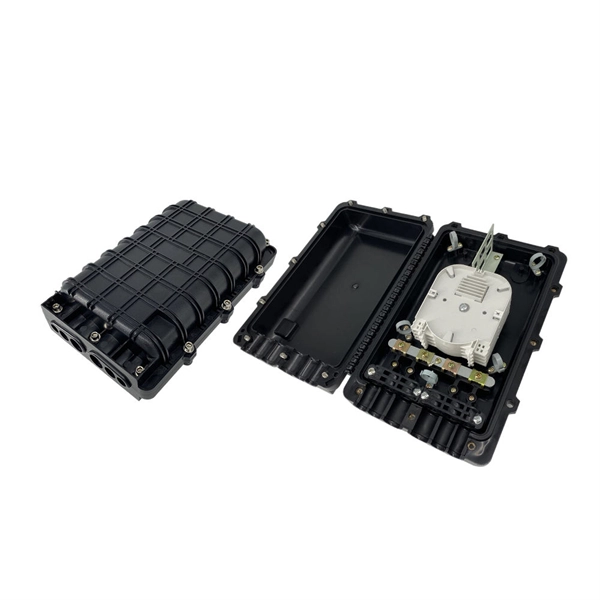
RIVO OPTICALSPLICE CLOSURES Technical Inquiry

The photoelectric conversion module can be plugged in directly

Certain photoelectric conversion modules are designed with card edge connectors, allowing them to be plugged directly into compatible sockets for electrical connection.Direct Plug-In Design

Some photoelectric conversion modules include a card edge connector at one end of the circuit board, which is specifically designed to fit into a card edge socket on an information system device. This design enables direct electrical connection without additional wiring or assembly, simplifying integration into electronic devices such as computers, sensors, or communication systems (US8669515B2) .

Module Construction

These modules typically consist of:

  • Transmission side photoelectric conversion part: Converts electrical signals into optical signals.
  • Reception side photoelectric conversion part: Converts optical signals back into electrical signals.
  • Circuit boards: Both transmission and reception parts are mounted on circuit boards, with the back surfaces positioned opposite to the housing.
  • Housing: Provides structural support and protection for the components. The card edge connector allows the module to interface directly with the device's socket, supporting high-speed data transmission and multi-channel communication without requiring additional connectors or adapters .
Advantages
  • Ease of installation: Modules can be inserted directly into compatible sockets.
  • Compact integration: Reduces the need for external wiring.
  • High reliability: Minimizes connection errors and mechanical stress.
  • Scalability: Supports multiple channels for bidirectional communication, though the connector width may increase with the number of channels .
Considerations

While direct plug-in modules simplify installation, it is important to ensure:

  • Socket compatibility: The card edge connector must match the device's socket dimensions.
  • Channel requirements: Modules with many channels may require wider connectors.
  • Environmental protection: Sealing layers may be necessary to protect the photoelectric conversion elements from moisture and oxygen, which can degrade performance over time (WO2023132136A1) . In summary, photoelectric conversion modules with card edge connectors are designed for direct plug-in use, providing a convenient and reliable method to integrate optical-electrical conversion into electronic systems.
The photoelectric conversion module can be plugged in directly

Photoelectric conversion element, photoelectric conversion module

According to the present disclosure, it is possible to provide a photoelectric conversion element that can maintain

US9470864B1

The photoelectric conversion module further comprises a housing composed of a first case and a second case, wherein the circuit

Metamaterial route to direct photoelectric conversion

Here, we propose a novel metamaterial route to convert the optical energy into dc electric energy directly from the

PHOTOELECTRIC CONVERSION ELEMENT,

The photoelectric conversion element and photoelectric conversion element module of the present disclosure can high power

PHOTOELECTRIC CONVERSION MODULE, ELECTRONIC

To increase the output of this photoelectric conversion element, a module structure may be used where a plurality of photoelectric

PHOTOELECTRIC CONVERSION ELEMENT, DEVICE, AND

In this manner, a direct current power supply module, which can supply electricity generated by receiving light in the

US8710356B2

A photoelectric conversion module, for example, a dye-sensitized solar cell, for generating electrical energy from light is disclosed. In

Photoelectric Conversion Module: A Comprehensive Review

A photoelectric conversion module converts light into electrical signals using a photodiode or APD, amplifying the current into a

Technical note

This reference is intended for preliminary fiber optic splice closure research. Compatibility, splice capacity, sealing class, tray layout, protection sleeves, installation methods, test limits and applicable standards must be verified for the specific project.

Still Have a Technical Question?

Use the inquiry form to describe a closure requirement, splice capacity or cable jointing question.

Start an Inquiry